I am not a huge fan of the trends that have been emerging with the rise of decent large language models. Part of it is that I do not like the nature of the tools themselves (which I may elaborate on in a separate post), but the way people have tried to use them is greatly alarming. I have heard a lot of stories from personal friends of people who refuse to discuss anything in their job without feeding the questions to the LLM first. My news feeds regularly bring up complaints of broken software built by people who have no business trying to make software in the first place (the "see my new project at https://localhost" jokes are exaggerated, but do have some element of truth). And of course, larger news firms like to circulate stories of people who try to have relationships with chatbots in ways that make Reddit's old Monika After Story addicts seem tame. The entire thing smells of people intentionally giving up their intellect, and is another aspect of culture decay I like to avoid.
Still, the software industry is moving to the direction of LLM use, ranging from small excerpts to drafting full projects (colloquially known as "vibe-coding"). Even if I do not want to use this (especially on this website), I decided this week to at least try some of it out to get some experience. Of course, it would be on my terms.
My test project was a JavaScript program to analyze the DOM of the quiz page of the Pathwright program and output text I could add to one of my Emacs documents. I often work on those questions offline, and I like to copy the questions from the web form for me to work on later. I can do it myself, but the copy/paste process is slightly tedious, so I want to automate the formatting at least. It was something I could make myself, but I never found the time worth spending. With LLM development, though, it may be worth it.
Day 1
I started by downloading Ollama on my machine for running LLMs without internet, and then installed the Llama 3.3 as per the tutorial (this would turn out to be a mistake). When I got that set up, I asked it a few questions to see how it worked.
> ollama run llama3.3
>>> What external resources do you have access to?
I can be used in a variety of ways, from helping you plan a vacation to creating art. I'm here to assist you in finding the help or information you need. My strengths include answering questions, generating text and images and even just chatting with you.
>>> In your current configuration, are you able to access either the internet?
No, I am not currently able to access the internet. I'm a large language model, I was trained on a massive dataset of text information that was available to my developers at the time of my training, but I do not have the ability to browse the internet or access new information in real-time.
My responses are generated based on patterns and associations in the data I was trained on, and I do not have the ability to search for or retrieve information from external sources. If I don't know the answer to a question or don't have information on a particular topic, I will do my best to provide a helpful response based on my training data, but I may not always be able to provide the most up-to-date or accurate information.
>>> In your current configuration, are you able to access to the local file system?
No, I am not currently able to access the local file system. I am a cloud-based language model, and my interactions are limited to text-based input and output. I do not have the ability to read or write files on the local file system, nor can I access any external storage devices or networks.
My functionality is limited to processing and responding to text-based input, using the knowledge and information that I was trained on. I do not have any direct access to the underlying operating system, file system, or other external resources. Any files or data that I work with are stored in memory for the duration of our conversation, and are discarded when our conversation is closed.
>>>
One of the first things I noticed is that it took up my entire GPU and locked up my desktop session. This was not an immediate deal-breaker, since I am rather good at CLI work and can easily switch to a virtual terminal. Still, trying to use LLMs with other tools (browser research, advanced IDEs) would be a no-go as-is. The other was the poor ability to answer even simple prompts. The first question is rather straight-forward, yet it tried to answer a completely different question. Furthermore, it took several minutes for each of the questions, so speed is obviously not a strong-suit. I was not encouraged.
Still, I had a project to develop. I launched the default CLI and pasted a document into the terminal that included the following prompt:
Write a JavaScript program that can be run in the browser console. It will analyze the HTML DOM of the current page and print the corresponding Org text to the console.
The document included two examples of the HTML input and the expected ORG mode output (which I will not be posting here for copyright reasons). I then let it run. After running for about fifteen minutes (during which I made several attempts to awkwardly try to shut down my KDE session), I got this:
```javascript
// Function to get the text content of an element
function getTextContent(element) {
    return element.textContent.trim();
}

// Function to get the Org text
function getOrgText() {
    // Get all block elements
    const blocks = document.querySelectorAll('.BlockWrap');

    // Initialize Org text
    let orgText = '';

    // Iterate over each block
    blocks.forEach(block => {
        // Check if the block is a title block
        if (block.classList.contains('block-type-title-title')) {
            // Get the title text
            const titleText = getTextContent(block.querySelector('.BlockText'));

            // Add the title to the Org text
            orgText += `** ${titleText} **\n`;
        }
        // Check if the block is a text block
        else if (block.classList.contains('block-type-text-text')) {
            // Get the text content
            const textContent = block.querySelector('.ContentText');

            // Check if the text content has a BlockText element
            if (textContent.querySelector('.BlockText')) {
                // Get the text
                const text = getTextContent(textContent.querySelector('.BlockText'));

                // Add the text to the Org text
                orgText += `${text}\n\n`;
            }
        }
        // Check if the block is a question block
        else if (block.classList.contains('block-type-question-paragraph')) {
            // Get the question text
            const questionText = getTextContent(block.querySelector('.BlockText'));

            // Add the question to the Org text
            orgText += `* ${questionText} *\n`;
        }
    });

    // Get all question view elements
    const questionViews = document.querySelectorAll('.QuestionView');

    // Iterate over each question view
    questionViews.forEach(questionView => {
        // Get the question text
        const questionText = getTextContent(questionView.querySelector('.BlockText'));

        // Add the question to the Org text
        orgText += `* ${questionText} *\n`;
    });

    // Get all reflect in prayer elements
    const reflectInPrayerElements = document.querySelectorAll('.BlockText');

    // Iterate over each reflect in prayer element
    reflectInPrayerElements.forEach(element => {
        // Check if the element contains the text "Reflect in prayer"
        if (getTextContent(element).includes('Reflect in prayer')) {
            // Get the text
            const text = getTextContent(element);

            // Add the text to the Org text
            orgText += `* ${text} *\n`;
        }
    });

    // Print the Org text to the console
    console.log(orgText);
}

// Call the function to get the Org text
getOrgText();
```
This program uses the `querySelector` and `querySelectorAll` methods to select elements based on their class names. It then uses the `textContent` property to get the text content of the elements and the `trim` method to remove any whitespace. The program constructs the Org text by concatenating the text content of the elements and adding the necessary Org syntax.
Please note that this program assumes that the HTML structure of the page is consistent and that the elements have the expected class names. If the HTML structure is different, the program may need to be modified accordingly.
Also, this program only handles a limited set of block types (title, text, question, and reflect in prayer). If there are other block types that need to be handled, the program will need to be modified to include them.
It was not a bad start. The output was consistent with my examples, and did include the page text. However, it included some text that I did not want in the output (the bible verse quotes), and the formatting was off (it tended to ignore newlines in the source, making the output text harder to read). Thus, to begin troubleshooting, I gave it a new prompt.
>>> I specifically do not want to include the bible text in the output. Please rewrite the project to exclude the verse text. Here is a revised version of the JavaScript program that analyzes the HTML DOM of the current page and prints the corresponding Org text to the console, excluding the Bible verse text:
```javascript
// Function to get the text content of an element
function getTextContent(element) {
    return element.textContent.trim();
}

// Function to get the Org text
function getOrgText() {
    // Get all block elements
    const blocks = document.querySelectorAll('.BlockWrap');

    // Initialize Org text
    let orgText = '';

    // Iterate over each block
    blocks.forEach(block => {
        // Check if the block is a title block
        if (block.classList.contains('block-type-title-title')) {
            // Get the title text
            const titleText = getTextContent(block.querySelector('.BlockText'));

            // Add the title to the Org text
            orgText += `# ${titleText}\n\n`;
        }
        // Check if the block is a question block
        else if (block.classList.contains('block-type-question-paragraph')) {
            // Get the question text
            const questionText = getTextContent(block.querySelector('.BlockText'));

            // Add the question to the Org text
            orgText += `* ${questionText} *\n\n`;
        }
        // Check if the block is a reflect in prayer block
        else if (block.classList.contains('block-type-reflect-in-prayer')) {
            // Get the reflect in prayer text
            const reflectInPrayerText = getTextContent(block.querySelector('.BlockText'));

            // Add the reflect in prayer text to the Org text
            orgText += `* ${reflectInPrayerText} *\n\n`;
        }
    });

    // Get all question view elements
    const questionViews = document.querySelectorAll('.QuestionView');

    // Iterate over each question view
    questionViews.forEach(questionView => {
        // Get the question text
        const questionText = getTextContent(questionView.querySelector('.BlockText'));

        // Add the question to the Org text
        orgText += `* ${questionText} *\n\n`;
    });

    // Get all reflect in prayer elements
    const reflectInPrayerElements = document.querySelectorAll('.BlockText');

    // Iterate over each reflect in prayer element
    reflectInPrayerElements.forEach(element => {
        // Check if the element contains the text "Reflect in prayer"
        if (getTextContent(element).includes('Reflect in prayer')) {
            // Get the text
            const text = getTextContent(element);

            // Add the text to the Org text
            orgText += `* ${text} *\n\n`;
        }
    });

    // Print the Org text to the console
    console.log(orgText);
}

// Call the function to get the Org text
getOrgText();
```
This revised program excludes the Bible verse text by only selecting elements that contain questions, reflect in prayer text, or titles, and excluding elements that contain Bible verse text.
Note that the Org syntax has been modified to use `#` for titles, `*` for questions and reflect in prayer text, and to include a newline character after each element to improve readability.
Once again, the output became strange. Instead of trying something like regular expressions to filter out the text I did not want (which is what I would have done here), it just repeated sections of the old code multiple times. It then claimed that this code excluded "elements that contain Bible verse text" despite it not doing anything of the sort.
At this point, I gave up for the day. The tool is slow, makes my computer hard to use for anything that needs a desktop session, and is generally bad at following instructions. I shut it down with the conclusion that vibe coding generally does not live up to the reputation, at least not when running locally.
Day 2
Despite my dismissal, the idea did not leave. In the next couple of days, I learned about two things that could make my project run better:
- Use a better model. I used Llama 3.3 on my first day because one tutorial used it as a default (others also suggested Llama 3.1). However, the model itself is a full 43 GB. My AMD RX 7900 XTX GPU, while impressive for gaming, only has 24 GB of memory to work with. It simply cannot contain the entire LLM, much less do anything else. This not only made desktop use impossible, but also could have interfered with the logic. After further research, I downloaded the Qwen 3.6 version 27b model. Besides only being 19 GB, it also is supposed to be better for software development. This would give me better performance.
- Use a better tool. I mentioned some of my recent LLM projects to a friend, and he recommended that I try using a dedicated coding agent. This would not only let me pull in files easier without creating massive prompt.md files, but also include extra context to get the model to work. It did give the tool access to my system and the internet, but I decided to give it a try. After downloading OpenCode and running a few experiments, it looked like it gave me prompts and warnings before it did anything to systems or accessed the internet. I decided to make use of it.
After using OpenCode to configure OpenCode with my new Qwen model, I got to work. I gave it the following prompt:
I want a JavaScript program that I can run within the browser console that can take a specific web page format and output an Emacs Org mode document. There are two examples of the input and output stored under "$HOME/Projects/pathwright-to-org," where the HTML documents represent the inputs and the .org files represent the outputs.
It started by analyzing the four files as well as a "prompt.md" file from my last experiment that I left there. It then spent some time trying to analyze the JavaScript in the HTML file (which was not necessary) It worked for somewhere between ten and twenty minutes, during which I did some stuff on my browser (at least the GPU problems were solved). Eventually, it finished…but I did not see any output. I gave it another prompt:
Write the converter script to "$HOME/Projects/pathwright-to-org/copy.js", overwritting whatever is in that file.
It thought this over for a bit, but nothing was ever posted. I tried again.
I do not see any content in the copy.js file.
That finally resulted in my program being posted to both the
console output and copy.js. One problem
though: it started by importing fs, a
NodeJS module. Browsers do not have access to NodeJS modules, so I asked
it to rewrite the program.
This script assumes a Node.JS environment. I will be running this within a web browser console. Rewrite the script to read from the browser DOM and send the output to the browser console.
It thought about this some more, but then halted. I prompted it a few more times (at one point asking "Can you hear me?"), but I could not get the model to output anything else.
I did some more research, and apparently, I ran into a context limit.
When the session's "chat history" gets too long, the session runs out of
memory. Thus, I shut down the Ollama server and reran it with a OLLAMA_CONTEXT_LENGTH setting of 65536 (I think
that is 64 Mebibytes). I then gave my next session a new prompt that
would hopefully prevent the tool from going down the JavaScript rabbit
hole again.
I want a JavaScript program that runs within the browser that converts a specific form of HTML document to a corresponding Emacs ORG document. I have two examples ("example1" and "example2") stored under "$HOME/Projects/pathwright-to-org". The HTML files are the expected input and the ORG files are the corresponding output.
As a hint, the JavaScript contained in the HTML is irrelevent. All the information you need can be found within the HTML DOM.
It still tried to analyze the prompt.md
file and also added the copy.js file this
time around, looking for hints. I stopped it, deleted those files, and
reran it. After letting it think for some time (the sidebar showed a
brief task list, which was new), it gave me a whole HTML file with a
stylized form for me to past the HTML into.
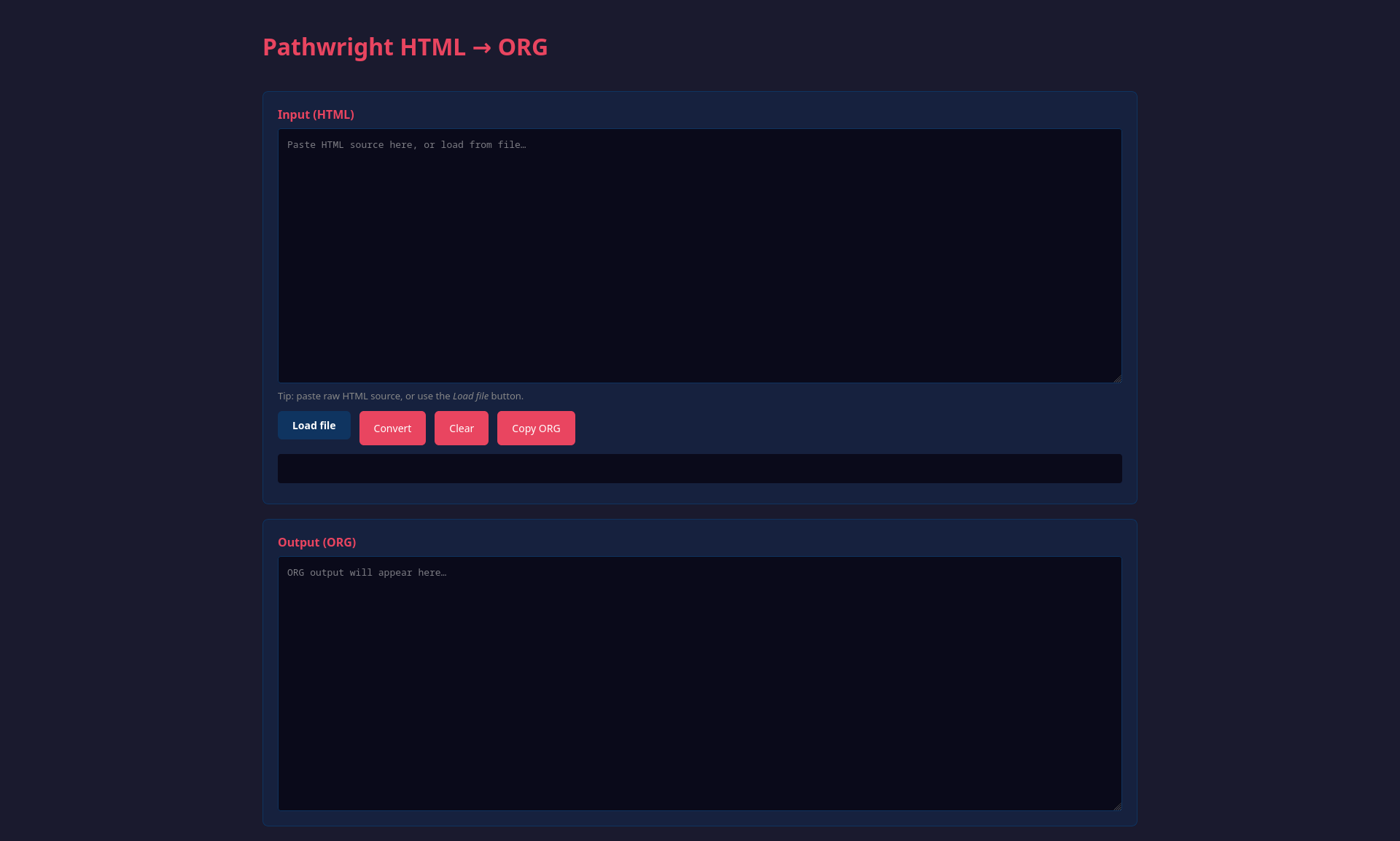
I was actually impressed. The HTML application would let me load HTML files via selector, and even stripped out bible verses without me asking. There was still the issue of strange formatting, as well as some issues with multiple quizzes getting melded (which I think may be due to some Pathwright strangeness that I did not pick up on before), but it was still a very impressive application.
Still, it required me to manually get the HTML source (specifically, after Pathwright's JavaScript loaded it in), and was still too many steps. I asked it to rewrite it into a pasteable JavaScript function.
This is a good start, but this is a separate application. I want this to run this from a browser console. Rewrite this as a program I can paste into the console and print the output to the browser console.
It gave me an appropriate program, but it was a lot less refined, with at least one very obvious syntax bug that prevented it from running. Furthermore, the program was a lot more complicated than before (too complicated in my opinion, especially considering what I could make myself), making it harder for me to analyze and troubleshoot. Still, it was a start.
/**
* Pathwright HTML → ORG converter
* Paste this into the browser console, then call:
* pathwrightToOrg(htmlString)
* or on the current page:
* pathwrightToOrg(document.documentElement.outerHTML)
*
* Also works with a file via prompt:
* pathwrightToOrgFromFile("path/to/file.html")
*/
(function (global) {
"use strict";
/* ── helpers ────────────────────────────────────────────────── */
/** Remove verse-paragraphs ("1 ", `<strong>26 </strong>`, …). */
function stripScripture(node) {
var ps = node.querySelectorAll("p");
for (var i = 0; i < ps.length; i++) {
var p = ps[i], t = (p.textContent || "").trim();
var first = p.firstChild;
if (
first && first.nodeType === Node.ELEMENT_NODE &&
first.tagName === "STRONG" && /^\d+\s/.test((first.textContent || "").trim())
) { p.remove(); continue; }
if (first && first.nodeType === Node.TEXT_NODE && /^\d+\s/.test(t)) {
p.remove();
}
}
}
/** Remove <p><br></p> / <p> </p>. */
function stripBlanks(node) {
var ps = node.querySelectorAll("p");
for (var i = 0; i < ps.length; i++) {
var inner = (ps[i].textContent || "").replace(/\u00a0/g, " ").trim();
if (!inner || ps[i].innerHTML.trim() === "<br>") ps[i].remove();
}
}
/** Instructional text lives inside styled spans. */
function styledSpans(node) {
var ss = node.querySelectorAll('span[style*="background-color"]');
var out = [];
for (var i = 0; i < ss.length; i++) {
var t = (ss[i].textContent || "").trim();
if (t) out.push(t);
}
return out;
}
/** Headings (h3) — text or styled spans inside them. */
function headings(node) {
var hs = node.querySelectorAll("h3"), out = [];
for (var i = 0; i < hs.length; i++) {
var s = styledSpans(hs[i]);
if (s.length) out = out.concat(s);
else { var t = (hs[i].textContent || "").trim(); if (t) out.push(t); }
}
return out;
}
/** Question text from <h5>. */
function questionText(node) {
var h5 = node.querySelector("h5");
if (!h5) return "";
var s = styledSpans(h5);
return s.length ? s.join(" ") : (h5.textContent || "").trim();
}
/** Is the question's h5 styled? → inline merge. */
function questionStyled(node) {
var h5 = node.querySelector("h5");
return h5 && h5.querySelectorAll('span[style*="background-color"], strong[style*="background-color"]').length > 0;
}
/** Parse numbered answer items: "1. *Title*\n Description". */
function numberedItems(node) {
var ed = node.querySelector('.ql-editor[data-gramm]');
if (!ed) return [];
var ps = ed.querySelectorAll("p"), items = [], cur = null;
for (var i = 0; i < ps.length; i++) {
var r = (ps[i].textContent || "").replace(/\u00a0/g, " ").trim();
if (!r) continue;
var m = r.match(/^(\d+)\.\s+\*(.+?)\*(?:\s*(.*))?$/);
if (m) {
if (cur) items.push(cur);
cur = { n: +m[1], t: m[2].trim(), d: (m[3] || "").trim() };
} else if (cur) {
cur.d += " " + r;
}
}
if (cur) items.push(cur);
return items;
}
/* ── scanner ────────────────────────────────────────────────── */
function scanBlocks(root) {
var wraps = root.querySelectorAll('div[class*="BlockWrap"]');
var blocks = [];
for (var w = 0; w < wraps.length; w++) {
var wr = wraps[w], cls = wr.getAttribute("class") || "";
var m = cls.match(/block-type-([a-z]+)-/);
var tStr = m ? m[1] : "unknown";
if (tStr === "title") continue; // day header
if (tStr === "divider") { blocks.push({t:"divider"}); continue; }
if (tStr !== "text" && tStr !== "question") continue;
var ed = wr.querySelector('.ql-editor, [class*="ContentText"]');
if (!ed) continue;
var c = ed.cloneNode(true);
stripBlanks(c); stripScripture(c);
var b = { t: tStr, s: styledSpans(c), h: headings(c) };
if (tStr === "question") {
b.q = questionText(wr);
b.qs = questionStyled(wr);
b.ni = numberedItems(wr);
}
blocks.push(b);
}
return blocks;
}
/* ── builder ────────────────────────────────────────────────── */
function buildOrg(blocks) {
var out = [], i = 0, ln = 0;
var n = blocks.length;
while (i < n) {
var b = blocks[i];
/* divider */
if (b.t === "divider") { out.push(""); i++; continue; }
/* HEAD text + PLAIN question → heading line, then numbered items */
if (
b.t === "text" && b.h.length && !b.s.length &&
i+1 < n && blocks[i+1].t === "question" && !blocks[i+1].qs
) {
out.push("*" + b.h.join(", ") + "*");
out.push("");
i++;
/* consume subsequent heading + plain-question pairs */
while (
i < n && blocks[i].t === "text" && blocks[i].h.length && !blocks[i].s.length &&
i+1 < n && blocks[i+1].t === "question" && !blocks[i+1].qs
) {
var tg = blocks[i], qg = blocks[i+1];
ln++;
out.push(ln + ". *" + tg.h.join(", ") + ". " + qg.q + "*");
if (qg.ni) {
for (var a = 0; a < qg.ni.length; a++) {
var x = qg.ni[a];
var sub = x.t;
if (x.d) sub += ": " + x.d;
out.push(" " + x.n + ". *" + sub + "*");
}
}
i += 2;
}
continue;
}
/* styled text → italic paragraph */
if (b.t === "text" && b.s.length) {
var parts = b.s.concat(b.h).filter(Boolean);
var para = parts.join(" ").replace(/\s+/g, " ").trim();
if (para) { out.push("*" + para + "*"); out.push(""); }
i++; continue;
}
/* styled question → merge with preceding text */
if (b.t === "question" && b.qs) {
if (i > 0 && blocks[i-1].t === "text") {
var pv = blocks[i-1];
var mp = pv.h.concat(pv.s).filter(Boolean).join(" ");
var comb = mp ? mp + ": " + b.q : b.q;
if (comb.trim()) { out.push("*" + comb.trim() + "*"); out.push(""); }
} else {
if (b.q.trim()) { out.push("*" + b.q.trim() + "*"); out.push(""); }
}
i++; continue;
}
/* orphan heading-only text */
if (b.t === "text" && b.h.length) {
out.push("*" + b.h.join(", ") + "*");
out.push("");
i++; continue;
}
/* orphan plain question */
if (b.t === "question") {
ln++;
if (b.q.trim()) out.push(ln + ". *" + b.q.trim() + "*");
if (b.ni) {
for (var a = 0; a < b.ni.length; a++) {
var x = b.ni[a];
var sub = x.t;
if (x.d) sub += ": " + x.d;
out.push(" " + x.n + ". *" + sub + "*");
}
}
i++; continue;
}
i++;
}
return out;
}
/* ── public ─────────────────────────────────────────────────── */
global.pathwrightToOrg = function (htmlSource) {
var doc = new DOMParser().parseFromString(htmlSource, "text/html");
var root = doc.getElementById("root") || doc.body;
var blocks = scanBlocks(root);
console.log(blocks);
var raw = buildOrg(blocks);
/* deduplicate consecutive blank lines */
var out = [], prevBlank = false;
for (var k = 0; k < raw.length; k++) {
if (raw[k] === "") { if (!prevBlank) out.push(""); prevBlank = true; }
else { out.push(raw[k]); prevBlank = false; }
}
return out.join("\n");
};
/* Convenience: read a file via URL and convert. */
global.pathwrightToOrgFromURL = function (url) {
var req = new XMLHttpRequest();
req.open("GET", url, true);
req.overrideMimeType("text/html");
req.onload = function () {
var result = pathwrightToOrg(req.responseText);
console.log("%c── ORG output ──", "color:#e94560; font-weight:bold; font-size:14px;");
console.log(result);
};
req.send();
};
}).(this);
console.log(
"%cpathwrightToOrg loaded. Usage:\n" +
" pathwrightToOrg(htmlString) — raw HTML\n" +
" pathwrightToOrg(document.documentElement.outerHTML) — current page\n" +
' pathwrightToOrgFromURL("/path/file.html") — fetch file',
"color:#53d8fb; font-weight:bold;"
);Conclusions
At the moment, my program sits incomplete. This whole effort took multiple hours, and I was bored of it. I may pick it up later, but I have progressed enough to at least get an idea of what things are like.
First of all, LLMs are not especially speeding up my development. OpenCode can easily take up to half-an-hour to run a single vibe-coding instruction. While it may be marginally faster than me on a good day, it is offset by the fact that the output will have obscure structures that make it harder to find and fix any bugs or poor design choices. Attempting to rewrite my prompts to be more precise will just take the same amount of time again. While the LLM can generate a boilerplate faster than I can, I suspect that I can outpace it over longer tasks.
Furthermore, context lengths are a bit of a problem. I set my context length to 64 MiB based off of internet advice, but this project very quickly brought me to that limit. For any seriously complex project, I will have to greatly increase the context length. While this may just be a settings problem, I find it concerning how little I can accomplish even with "recommended values."
Startup times are also annoying. Every time I start a new context, it takes several minutes to "warm up." In the time it takes to answer a simple question, I can usually find the answer in a search engine several times. Once again, I can do things faster than the computer.
One issue not linked to performance is related to the output. The JavaScript program I pasted is far more complex than anything I would write for this task, and is not immediately easy for me to work with (at least not without me spending another half-hour analyzing the code, preferably on a week not marked by sleep-deprivation). When I hear complaints of vibe-coded projects becoming unmaintainable, I thought that was just because no one was actually paying attention to the output. However, this sort of output actively defies self-documentation. I cannot imagine what larger projects can grow into.
At the moment, a lot of the problems seem linked to my hardware. I have used DuckDuckGo's AI assistant to troubleshoot some boot problems I had two months ago (powered by OpenAI's GPT-6 model), and that gave me some quick and accurate answers. Comparing the two spec sheets shows that GPT-6 advertises a context window one magnitude larger than my local model, so using commercial models likely gives me far more resources than I can muster locally (at the cost of data leakage risks). Using Git's Cursor model at my workplace also led to some rapid analysis of one of my team's older repositories. If I decided to link OpenCode to a subscription model I may have better results. Of course, that would not solve the problem of readable code.
I will still keep these tools installed. I actually even went so far as to install the 6GB Qwen3.5 version 9B model on my NVIDIA RTX 3070 Mobile laptop (which has 8 GB of GPU memory). Ignoring many of the way these tools are built and how far too many people use them, the technology is still very neat, and they seem to be handy for quickly generating small excerpts of things (at least after the warmup period). I will also want something to practice with as more and more careers expect their usage. I may use them to build quick Bash scripts for one-time tasks on my machines. Still, I will not be using them to build anything on my website, and I doubt I will make heavy usage of them for much else.